If your car is overheating while driving, it’s understandable to feel torn between “keep going to get somewhere safe” and “stop before I ruin the engine.” This article will help you make that decision calmly: what the pattern usually means, what to do in the moment, what you can check safely on the roadside, and which problems commonly cause overheating at speed. If you’re in Durham and you need help moving the vehicle to a safer location or off the road, you can call Durham Towing Company at 1-919-805-3344.
Car overheating while driving (but not at stops): what it usually means
When a car overheats at higher speeds, it often points to a cooling system problem that shows up under load. Driving increases engine workload, heat output, and cooling system pressure. If something is weak, restricted, or low, the system may keep up around town but fall behind on the highway or on hills.
This pattern is different from “overheats at idle.” Idle overheating frequently involves airflow at low speed, like an electric cooling fan not turning on. Overheating while driving more often involves coolant flow, pressure, or the radiator’s ability to shed heat.
That said, real life is messy. Some issues can cause both patterns, and modern vehicles may go into a reduced-power mode that changes symptoms. Your goal is not to diagnose perfectly on the shoulder. Your goal is to prevent engine damage and get the car to a safe place.
What to do right away (before you damage the engine)
The safest default is to treat overheating as urgent. If the temperature gauge is climbing toward hot, or the warning light comes on, take action immediately.
First, reduce load. Turn off the A/C. Ease off the accelerator and avoid hard acceleration. If you’re climbing a long grade, consider taking the next exit or pulling into a safe turnout.
Next, find a safe place to pull over. Do not stop in a blind curve or a narrow shoulder if you can avoid it. Hazard lights on, and aim for a parking lot or wide shoulder when possible.
Once you stop, keep these safety points in mind:
- Do not open the radiator cap while the engine is hot. The system is pressurized, and hot coolant can spray out and cause serious burns.
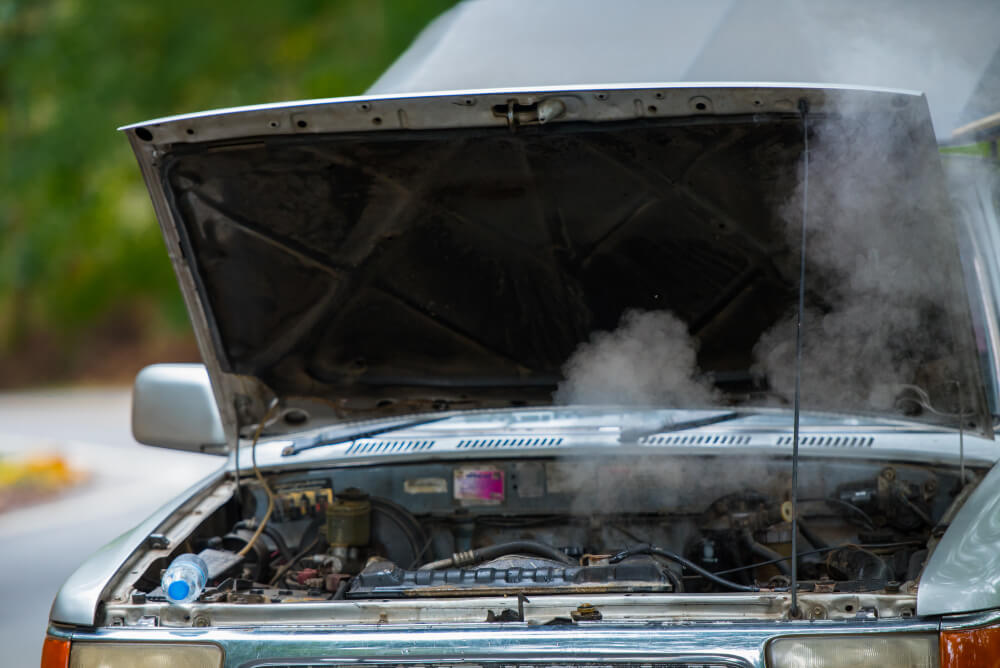
- Let the engine cool. Opening the hood can help heat escape, but keep your hands away from moving parts and watch for steam.
- If the temperature is high and still rising, shut the engine off. If it’s just started to climb and you’re stopping immediately, some vehicles may cool better at idle, but if you’re unsure, err on the side of shutting it down.
If you see a red temperature warning, hear alarming noises, or notice thick steam, it’s usually smarter to stop and arrange assistance than to “try your luck” for a few more miles.
Quick checks you can do on the roadside (without tools)
After the engine cools down, you can do a few simple checks that help you decide what to do next.
Start with the obvious: look under the car for coolant dripping or pooling. Coolant can be different colors depending on what’s in the system, so focus more on the fact that it’s wet and coming from the engine area than on the exact color. A sweet smell can also suggest coolant, though you should not rely on smell alone.
Look at the dash and gauge behavior. Did it climb steadily over several minutes? Did it spike suddenly? A steady climb can fit a slow loss of cooling capacity, like low coolant, partial blockage, or a circulation problem. A sudden spike can sometimes happen when the thermostat sticks closed or when coolant level drops enough that the temperature sensor stops reading correctly.
If it’s safe and you can do so without reaching into danger, check whether the radiator fan runs at any point. Some cars run the fan with the A/C, some run it based on temperature, and some will not run it if the engine is off. The exact behavior varies, so treat this as a clue, not proof.
If you have coolant available and the engine has cooled, you can check the coolant reservoir level. If it’s clearly low, topping up may help you move the car to a safer location. Use the correct coolant if you have it. If you do not, some drivers add water in an emergency. Water can be a short-term option, but it is not ideal long-term and can be risky in freezing conditions. Also, if the system is leaking badly, adding fluid may only buy you a very short distance before it overheats again.
If you cannot safely confirm coolant level, or you suspect a major leak, it’s better to avoid experimenting on the roadside.
Most common reasons a car overheats while driving
Overheating at speed usually comes down to one of a few themes: not enough coolant, coolant not circulating correctly, the system not holding pressure, or heat not transferring well through the radiator.
Low coolant is a big one. A slow leak can go unnoticed until you take a longer drive. At highway speed, higher RPM and higher pressure can turn a small leak into a fast loss of coolant. Hoses, the radiator, and fittings are common leak points, but the exact source varies.
A radiator cap that can’t hold pressure can also cause overheating. The cooling system is designed to run pressurized, which raises the boiling point of coolant. If pressure can’t build properly, coolant can boil sooner, and the system loses efficiency. This can be tricky to spot without the right tools.
Clogging or restriction is another common issue. The radiator can be restricted internally by deposits over time, or airflow can be blocked externally by debris. At speed, you would think airflow alone solves overheating, but if coolant can’t flow well through the radiator, or the radiator can’t transfer heat efficiently, more air won’t fix the underlying limitation.
Thermostat issues can show up while driving too. If a thermostat sticks closed or opens late, coolant circulation through the radiator may be limited just when the engine needs it most. Some thermostats fail in ways that cause intermittent overheating, which makes the problem feel unpredictable.
Water pump problems can also appear “mostly fine” until you’re driving faster or longer. If the pump impeller is damaged or slipping, coolant circulation may be weak under load. This is not something you can confirm on the shoulder, but it’s a common cause when overheating is tied to driving rather than idling.
Hoses can fail in less obvious ways, too. A hose can collapse internally at speed, restricting flow, or a blockage can limit circulation. These issues can mimic other problems.
Even though fans are often tied to idle overheating, certain fan or shroud problems can contribute while driving, especially in stop-and-go traffic that still involves bursts of speed. Again, vehicle design matters, so treat this as a possibility rather than a rule.
“Can I keep driving?” How to decide in the moment
If your car is overheating while driving, the least risky option is usually to stop and let it cool, then reassess. Continuing to drive an overheating engine can lead to warped cylinder heads, head gasket failure, or other expensive damage. The exact threshold varies by engine and how hot it got, which is why the safest advice is conservative.
There are a few situations where moving the car a short distance may be reasonable, such as getting from a narrow shoulder to a nearby parking lot. But that only makes sense if the temperature is stable or dropping, you have turned off the A/C, and you are not seeing warning signs like heavy steam, knocking noises, or a sudden loss of power.
If you have to move a short distance, keep it gentle. Drive slowly, avoid hard acceleration, and watch the gauge. If the temperature starts climbing again, stop immediately.
If the car overheats quickly every time you start driving, or you see obvious coolant pouring out, the safest call is to shut it down and get help rather than trying repeated “cool down and go” cycles.
What to tell a mechanic (so diagnosis is faster)
The details you share can save time and money because overheating can have multiple root causes.
Tell them when it happens: only on the highway, only on hills, only with the A/C on, or after a certain amount of time. Mention the weather conditions and whether you were towing anything or carrying a heavy load.
Also share what you observed: any puddles under the car, steam from the front, a sweet smell, the heater blowing cold when it should be hot, or the temperature gauge spiking suddenly. Even if you’re not sure what it meant, those observations matter.
Preventing a repeat overheating incident
If the car overheated once, it’s worth treating it as a warning sign. Cooling systems are maintenance items, and problems often start small.
Regularly checking coolant level in the reservoir can help you catch slow leaks early. Having the correct coolant for your vehicle matters because different formulations are not always compatible. If you’re unsure what coolant you need, check the owner’s manual or ask a shop.
It also helps to address small symptoms before they turn into a breakdown. A coolant smell after driving, a reservoir level that slowly drops, or a heater that sometimes blows cool can all be early clues.
When to call for roadside assistance instead of troubleshooting
If you’re on a busy road, if you’re not confident working around a hot engine, or if the temperature warning is severe, it’s often safer to call for roadside help and focus on staying safe. The same is true if you see a large leak, heavy steam, or the car repeatedly overheats as soon as you start moving.
For drivers in Durham who need roadside assistance to get out of a dangerous spot or to transport the vehicle for repair, Durham Towing Company can help. Save the number now so you’re not searching later: 1-919-805-3344.
The main takeaway is simple: overheating while driving usually means the cooling system can’t keep up under load, and pushing your luck can turn a fixable issue into engine damage. Reduce load, get to a safe stop, let it cool, and choose the cautious next step based on what you observe.